Hypothyroid Symptoms vs. Everyday Realities: The Science of Fatigue, Weight, and Anxiety
If you search the internet for symptoms like “fatigue,” “weight gain,” or “anxiety,” you will inevitably find thousands of pages pointing to thyroid disease. It is easy to conclude that a sluggish or overactive thyroid is the singular root cause of how you feel.
However, to maintain clinical credibility and protect your health, we must separate physiological fact from internet myth. While thyroid hormones are powerful modulators of systemic cellular function, these symptoms are highly non-specific and can be driven by dozens of non-thyroid pathways.
Let’s look at the exact cellular biology of how the thyroid influences your energy, weight, and nervous system—and what else your doctor must rule out.
Fatigue and Brain Fog: Conduction Velocity and CNS Sluggishness
The Cellular Mechanism
Thyroid hormones (T3 and T4) are essential for the normal development, myelination, and excitability of the central and peripheral nervous systems.
When T3 levels are deficient inside the neuron:
- Nerve Conduction Velocity Slows: This prolongs peripheral reflex action times and delays neuromuscular signaling.
- Apathy and Somnolence Occur: In the brain, this electrical and chemical sluggishness manifests clinically as physical listlessness, excessive sleepiness (somnolence), slowed speech, and impaired short-term memory.
Crucial Alternative Diagnoses to Rule Out
Fatigue is the single most common symptom reported in primary care medicine, and the vast majority of cases are not thyroid-related. Alternative causes of fatigue include:
- Anemia (Iron Deficiency): Lacking adequate iron impairs hemoglobin’s ability to transport oxygen to tissues, starving mitochondria of the oxygen required for aerobic respiration.
- Sleep Apnea: Repeated, brief airway collapse during sleep disrupts sleep architecture, preventing the deep sleep phases when restorative growth hormone is secreted.
- Vitamin D Deficiency: Essential for skeletal muscle calcium homeostasis and immune function.
- Clinical Depression: Directly alters neurotransmitter pathways (serotonin and norepinephrine) independent of endocrine function.
Weight Changes: BMR, Myxedema, and Water Retention
The Cellular Mechanism
A common misconception is that hypothyroidism causes massive adipose tissue accumulation (fat storage). While T3 does regulate lipid storage and lipolysis, severe hypothyroid-related weight gain is rarely driven by a sudden increase in fat mass.
Instead, the clinical weight changes are driven by two distinct physiological processes:
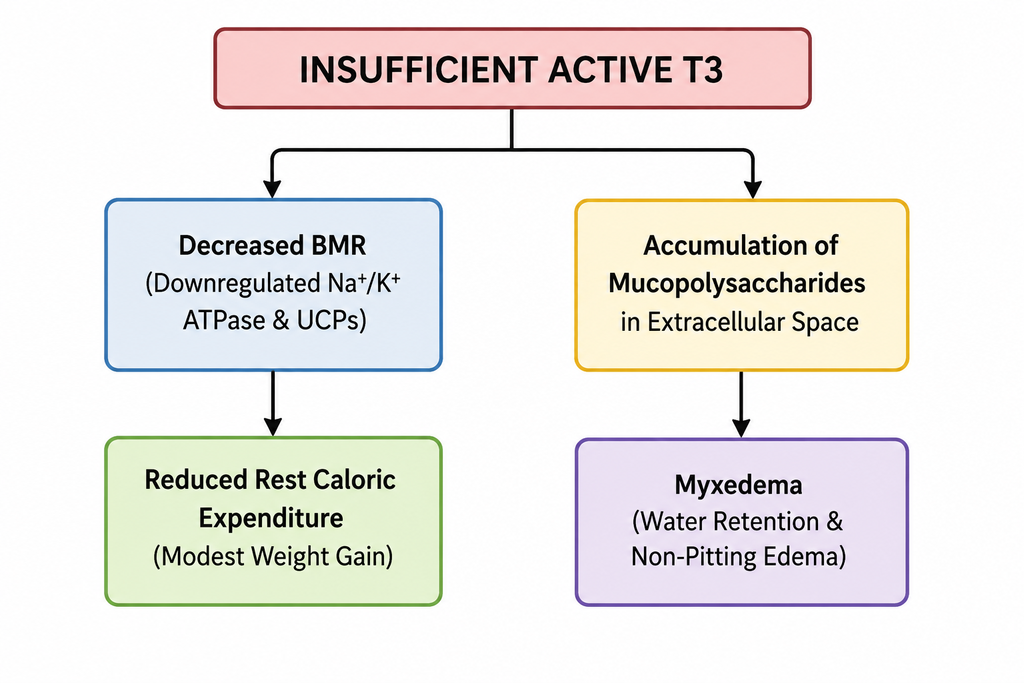
- Downregulation of Basal Metabolic Rate (BMR): T3 stimulates metabolic energy expenditure by upregulating the transcription of Na+/K+ ATPase pumps (which consume up to 20% of resting cellular energy) and mitochondrial uncoupling proteins (UCPs, or thermogenin). In hypothyroidism, BMR drops, reducing resting caloric expenditure. This typically causes only a modest, minor weight gain of 5 to 10 pounds.
- Myxedema Fluid Retention: The primary driver of significant hypothyroid weight gain is myxedema. Lacking thyroid hormone, a mucus-like material complexed with hyaluronic acid and chondroitin sulfate accumulates in the extracellular matrix, particularly within the skin and interstitial spaces. Because of its powerful osmotic effect, this matrix traps water, causing generalized non-pitting edema (fluid retention).
Crucial Alternative Diagnoses to Rule Out
If you are experiencing rapid or substantial weight gain, your physician must evaluate:
- Insulin Resistance or Type 2 Diabetes: Impaired glucose transport leads to chronic hyperglycemia and redirects excess caloric intake into adipose tissue storage.
- Hypercortisolemia (Cushing’s Syndrome): Elevated cortisol levels promote skeletal muscle proteolysis (muscle wasting) while directing lipogenesis to the torso and face (truncal obesity and “moon face”).
- Cardiovascular or Renal Failure: Impaired glomerular filtration or poor cardiac pumping capacity disrupts Starling forces, causing rapid extracellular fluid accumulation (edema) in the lower extremities.
Can Thyroid Problems Cause Anxiety and Panic?
The Cellular Mechanism
While hypothyroidism slows down cellular systems, hyperthyroidism (excess T3 and T4) does the exact opposite. If you are experiencing unexplained anxiety, panic attacks, or irritability, your thyroid may be hypersensitizing your nervous system.
Thyroid hormones behave as systemic “amplifiers” or “gain controls” for the sympathetic nervous system761. Specifically, excess T3 and T4:
- Upregulate Beta (β)-Adrenergic Receptors: They dramatically increase the density of these receptors in cardiac and nervous tissue.
- Upregulate Stimulatory G-Proteins (Gαs): This amplifies the intracellular cyclic AMP (cAMP) cascade whenever epinephrine or norepinephrine binds to the cell surface.
Because of this molecular amplification, even normal physiological surges of adrenaline produce an exaggerated, hyperactive tissue response. This manifests as tachycardia (rapid heart rate), hand tremors, heat intolerance, sleep disruption, and a sense of chronic sympathetic panic or “fight-or-flight” anxiety.
Crucial Alternative Diagnoses to Rule Out
Anxiety and panic are complex neuro-psychological phenomena. Alternative or contributing causes include:
- Generalized Anxiety Disorder (GAD): Chronic hyper-excitability of central nervous system pathways, often unrelated to endocrine abnormalities.
- Excessive Caffeine or Stimulant Use: Blocks adenosine receptors and directly drives sympathetic heart rate and central nervous system arousal.
- Adrenal Medullary Overactivity (Pheochromocytoma): A rare tumor of the chromaffin cells in the adrenal medulla that autonomously secretes massive bursts of epinephrine and norepinephrine directly into the blood, causing sudden panic, sweating, and severe hypertension.