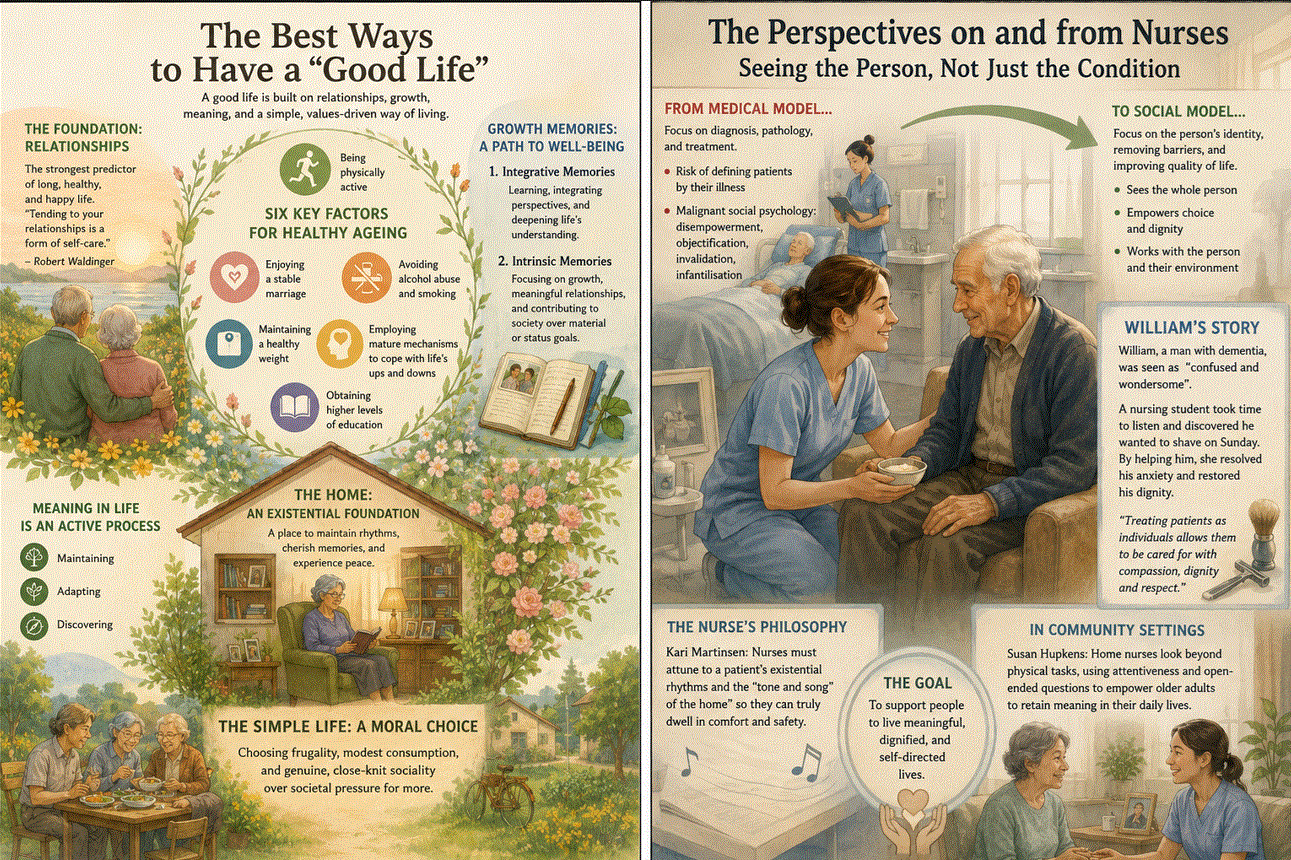
According to nearly eight decades of data from the Harvard Study of Adult Development, the single most powerful predictor of a long, healthy, and happy life is the quality of our relationships. Psychiatrist Robert Waldinger notes that “tending to your relationships is a form of self-care too”(Mineo, 2017). The study found that people who were most satisfied with their relationships at age 50 were consistently the healthiest at age 80. Furthermore, psychiatrist George Vaillant identified six primary factors that predict healthy ageing:
- Being physically active
- Avoiding alcohol abuse and smoking
- Employing mature mechanisms to cope with life’s ups and downs
- Maintaining a healthy weight
- Enjoying a stable marriage
- Obtaining higher levels of education (which correlates with healthier lifestyle choices)
Beyond physical health, psychological research indicates that the “good life” requires a balance between social-cognitive maturity (thinking richly about one’s psychosocial life) and social-emotional well-being (feeling good about it) (Bauer et al., 2005). A powerful way to cultivate this is by framing one’s past experiences around growth memories. These fall into two eudaimonic categories:
- Integrative Memories: Emphasising learning, integrating multiple perspectives, and coming to a deeper conceptual understanding of life’s lessons.
- Intrinsic Memories: Focusing on humanistic, self-determined pursuits such as personal growth, fostering meaningful relationships, and contributing to society rather than chasing extrinsic or materialistic goals like money and status.
For older adults, having a good life and retaining meaning in life (MiL) is a continuous, active process of maintaining, adapting, and discovering. This is deeply tied to the home, which serves as an existential foundation for autonomy, identity, and “dwelling”—allowing individuals to maintain their personal rhythms, cherish memories, and experience peace.
Finally, a distinct moral perspective from return migrants suggests that a good life can also be achieved by actively pursuing a “simple life”. This involves consciously rejecting societal pressures for upward socio-economic mobility and instead prioritising frugality, modest consumption, and genuine, close-knit sociality.
The Perspectives on and from Nurses

Within healthcare and social support, professional perspectives highlight a critical shift from a strictly Medical Model of care to a Social Model.
- The Limitations of the Medical Model: Historically, healthcare has been dominated by a professionally led, medical framework focused heavily on diagnosis, pathology, and clinical treatment. While crucial for diagnosis, relying solely on this model risks defining patients by their illness. It can foster a culture of malignant social psychology, which manifests as disempowerment, objectification, invalidation, and infantilisation.
- The Power of the Social Model: The Social Model, which underpins personalisation, views a person’s condition as only a part of their identity and focuses on removing environmental and relational barriers to improve their overall quality of life.
This distinction is powerfully illustrated by William’s story, a case from a clinical nursing placement discussed by Murphy and Patel (2025):
William, a hospital patient with dementia, was described by the ward’s standard nursing staff as “confused and wondersome”. Because he was constantly walking toward the bathroom, the staff repeatedly guided him back to bed to manage his perceived risk. However, an observant nursing student took the time to talk to William and discovered a simple, logical cause: William was accustomed to shaving every Sunday, possessed a safety razor in his pocket, and wanted a shave. By escorting him to the bathroom and helping him foam his face, the student resolved William’s anxiety, leaving him calm and chatty for the rest of the day. The student reflected that this experience reaffirmed “the importance of treating patients as individuals and supporting their choices so that they can be cared for with compassion, dignity and respect”.
Furthermore, care philosopher Kari Martinsen asserts that the primary task of a healthcare professional is to perceive a patient’s existential rhythms. Rather than treating patients as merely “inhabiting” a physical space, nurses must enter care environments with openness, attuning themselves to the unique “tone and song” of the home to help patients truly “dwell” in comfort and safety (Hupkens et al., 2020).
In community-dwelling settings, qualitative nursing research by Susan Hupkens emphasises that home nurses must look beyond standard physical tasks. Nurses are encouraged to utilise a phenomenological attitude of attentiveness and open-ended questioning to design person-centred interventions that actively empower aged clients to retain meaning in their daily lives.
References
Bauer, J. J., McAdams, D. P., & Sakaeda, A. R. (2005). Interpreting the good life: Growth memories in the lives of mature, happy people. Journal of Personality and Social Psychology, 88(1), 203–217. https://doi.org/10.1037/0022-3514.88.1.203
Hupkens, S., Goumans, M., Derkx, P., & Machielse, A. (2020). ‘Meaning in life? Make it as bearable, enjoyable and good as possible!’: A qualitative study among community‐dwelling aged adults who receive home nursing in the Netherlands. Health & Social Care in the Community, 29(1), 78–90. https://doi.org/10.1111/hsc.13071
Mineo, L. (2017). Good genes are nice, but joy is better. Harvard University. Harvard Gazette. https://news.harvard.edu/gazette/story/2017/04/over-nearly-80-years-harvard-study-has-been-showing-how-to-live-a-healthy-and-happy-life/
Murphy, L. L., & Patel, J. (2025). Skills for personalised support. Living a Good Life with Dementia, 143–188. https://doi.org/10.4324/9781041056102-6